


8 Ball Pool
Miniclip.com
I keep coming back to 8 Ball Pool for one simple reason: it turns a familiar table game into a quick online contest that is easy to start but surprisingly demanding to master. Developed by Miniclip.com, this free sports game focuses on multiplayer and player-versus-player pool matches, so the main appeal is not collecting content or following a long story. It is the feeling of lining up one shot, judging the angle, and trying to stay calm when the whole match depends on your next move.
That focused idea has helped it become one of the most widely played pool games on mobile. It has passed a billion installs and holds an average rating of 4.8 from around 31 million ratings, which tells me that its basic formula works for a very large audience. I would not call it perfect, though. The same competitive structure that makes a short match exciting can also make losses feel personal, especially when I am playing quickly or taking risks I would not try on a real table.
Why the online pool match is the real attraction
The important capability here is the direct online match. Instead of practicing against an empty table or playing through a solitary challenge, I am usually preparing a shot with another player waiting on the other side. That changes the rhythm completely. A simple opening break becomes a decision about control, and a routine-looking pot can become a test of patience because leaving the cue ball in the wrong place may give the opponent an easy finish.
Related News

Basketball Stars: Multiplayer Dominates Mobile Sports Gaming

Canva on Mobile Is Excellent for Most Creators, but Not Every Workflow

Google Maps Go: Leading the Way in Android Navigation
I like this more than a purely casual pool simulator because every turn has a consequence beyond the current ball. The strongest shot is not always the most obvious one. Sometimes I aim for a difficult pot because it opens the table; at other times, I choose a safer shot that keeps the cue ball away from a dangerous pocket or leaves a less comfortable position. The game rewards thinking one or two shots ahead, even when a match only takes a few minutes.
The controls are built around a familiar mobile routine: adjust the aim, set the power, and release the shot. That sounds basic, but small changes matter. Aiming directly at a ball may pocket it while sending the cue ball somewhere useless. Pulling back too much power can make a shot harder to control, while using too little may leave the target near the pocket without enough momentum. I found that the most useful improvement was not simply learning to pot more balls; it was learning to plan where the cue ball should stop.
Related News

Why WhatsApp Messenger Still Makes Everyday Communication Feel Easy

Jurassic World: The Game Is the Better Dino Tycoon for Strategic Players

Threads in Real Life: Who Should Join, Lurk, or Leave

How SHEIN Turned Shopping Into an Endless Content Feed

How to Make Fortnite Feel Smarter on Mobile

Should You Switch to Microsoft Outlook on Mobile?
The biggest difference between a lucky player and a reliable player is cue-ball control. I started treating each shot as two problems instead of one: where the object ball should go and where the cue ball should finish. That habit makes the online format more interesting because it gives me something meaningful to improve even when I am not winning consistently.
How a match feels in practice
A typical session works well when I have only a short break. I can open the game, enter a match, and concentrate on a compact series of turns instead of committing to a long campaign. That makes it a natural fit for a commute, a waiting room, or a few minutes at home when I want competition without learning a complicated ruleset first.
The short format also makes momentum important. If I miss an early shot, I may not get another chance for a while. A confident opponent can clear several balls in succession, and watching that happen is a useful lesson in why defensive thinking matters. I used to treat a difficult shot as something I should attempt immediately. Now I am more likely to ask whether missing would give the other player the whole table.
Gallery
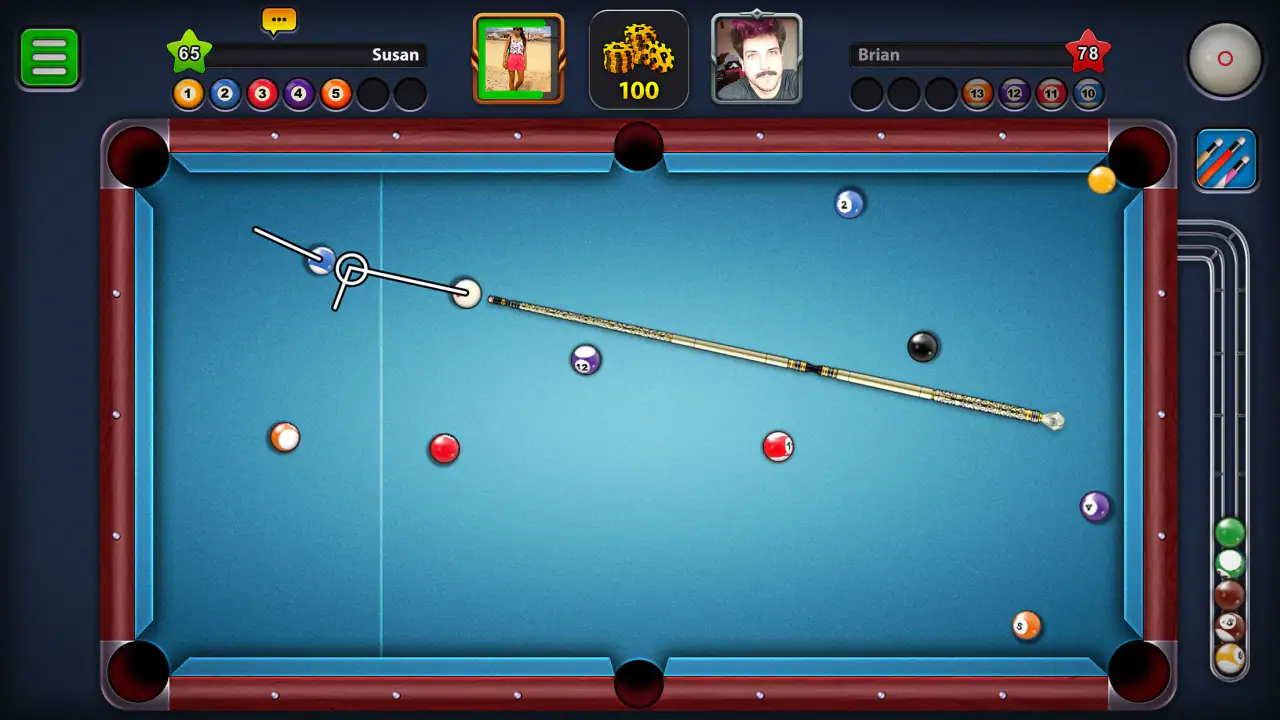
That question is especially valuable during the break. A powerful opening can spread the balls, but it does not automatically create a good next shot. I prefer a controlled break when I am trying to understand the table rather than chase a dramatic start. After the break, I look for a group of balls that offers a natural route, then identify which ball might cause trouble later. This approach is less flashy, but it reduces the number of desperate shots near the end.
Mobile pool has one practical weakness compared with a physical table: the screen gives me less physical feedback. On a real table, I can walk around, inspect angles from different positions, and feel the scale of the shot. On a phone, I am working with a compact visual interface and touch input. That is convenient, but it means I need to slow down and inspect the line rather than trusting the first aim that looks right.
I also recommend avoiding rushed taps. When I am playing one-handed or while distracted, I tend to adjust the aim repeatedly and lose track of the original plan. A better routine is to choose the target pocket first, check the cue-ball path, make one careful adjustment, and then set power. This is a small workflow change, but it makes the controls feel much more predictable.
The best everyday use case
For me, the game is at its best during a short break when I want a social contest but do not want to coordinate with friends in real time. The online player-versus-player structure supplies an opponent immediately, and the rules are familiar enough that I can focus on decisions rather than instructions. It works particularly well for someone who already enjoys watching or playing pool but does not have access to a table.
Imagine finishing lunch with ten minutes before a meeting. I can play one match, concentrate on positioning, and stop when it ends. If I win, the satisfaction comes from having managed the table. If I lose, I can usually identify the turning point: an overly strong break, a missed safety opportunity, or a risky shot attempted without a backup plan. That makes the session feel more useful than a random arcade round.
It is also a good choice for friendly competition when everyone wants the same simple activity. The game is recognizable enough for a newcomer to understand the objective, but the online format gives experienced players room to show judgment. I would still explain that the first few matches may feel unforgiving. Someone who already understands angles and positioning can take control quickly, so new players should not judge the whole experience by an early losing streak.
One practical tip is to play with a stable connection and enough attention to finish a turn properly. Pool is not a good background activity when I am switching between messages, music controls, and the match. A moment of distraction can change the aim or make me release the shot before checking the cue-ball route. The game is casual in length, but the individual decisions deserve more focus than its quick sessions might suggest.
Where the trade-offs appear
The free entry is a strong advantage. I can try the core game without paying upfront, and the Everyone content rating makes it suitable for a broad audience. At the same time, the game includes in-app purchases ranging from ten cents to $299.99 per item. That does not prevent me from playing, but it does mean I would approach spending carefully, especially if competition starts encouraging me to buy something after a disappointing run.
My advice is to decide before playing whether I am treating it as a free occasional game or as a hobby worth spending on. Those are different expectations. If I am only looking for quick matches, the free experience is enough to judge whether the aiming and online competition suit me. If I start chasing progression or trying to compete more seriously, I should keep a clear personal limit rather than making purchases in response to frustration.
Another trade-off is the emotional effect of online play. A victory feels more meaningful than beating a predictable computer opponent, but a loss can feel harsher because another person took advantage of my mistake. I have had matches where one poor decision ended what looked like a promising run. That tension is part of the appeal, yet it will not suit someone who wants a completely relaxed game with no pressure.
Compared with a traditional offline pool app, this one gains energy from real opponents but loses some of the calm control of solo practice. Compared with a physical table, it is cheaper, more portable, and easier to start, but it cannot reproduce the full sense of space or the social atmosphere of playing face to face. Compared with a general arcade sports game, it is narrower and more deliberate: there is less variety, but the central skill has more room to develop.
The age rating is Everyone, which fits the straightforward sports presentation. Still, parents may want to discuss spending habits if a child uses the game, because optional purchases can reach a high individual price. I would also recommend checking the device before installing: the current version is 56.25.1 and requires Android 6.0 or later. That is useful to know if I am trying to run it on an older phone or tablet.
Small decisions that improve the experience
The first useful technique is to stop aiming only for the current pot. Before taking the shot, I look at the likely next ball and ask whether the cue ball can reach a comfortable area afterward. If the answer is no, I consider a softer shot or a different route. This is more reliable than repeatedly increasing power and hoping the cue ball lands well.
The second is learning when not to attack. A defensive choice can be better when the table is awkward or when a missed pot would leave an easy opening. I do not use this approach every turn, because overly cautious play can create its own problems, but it is valuable when the opponent has a clear run. The online format makes this insight especially important: denying a simple shot may be more useful than attempting a spectacular one.
The third is to treat the final ball as part of the plan from the beginning. I have lost matches after clearing nearly everything because I left the last difficult ball until the end. When I scan the table early, I can decide whether that ball needs to be played sooner, used to reposition the cue ball, or approached from a particular side. This habit turns the table from a collection of separate targets into a route.
A fourth tip is to use practice matches as experiments rather than judging them only by the result. I might spend one session focusing on gentle power, another on avoiding scratches, and another on choosing safer positions. That gives each match a purpose. It also reduces the temptation to chase a win with increasingly aggressive shots after making a mistake.
Who will gain the most from it?
I would recommend this game to people who want a compact competitive sports experience, enjoy familiar rules, and like improving through repeated decisions. It is especially suitable for players who appreciate games where a small technical adjustment can change the outcome. The free price makes it easy to test, while the large player base suggests that finding the online side of the experience is central to its appeal.
It is less suitable for someone seeking a detailed career mode, a broad collection of sports, or a purely offline pastime. It may also frustrate players who dislike losing because of one mistake or who prefer games that can be played while barely paying attention. The online format asks me to accept that another player may capitalize on every weak position, and the purchase options require a little self-control.
Miniclip.com has kept the concept focused: this is a sports game about playing pool against other people, not a substitute for every kind of billiards experience. That focus is why I can return after a long break and understand what I am doing almost immediately. The depth comes from execution and judgment rather than a large number of systems to memorize.
After spending time with it, my view is positive but measured. 8 Ball Pool is strongest when I want a fast online match that rewards patience, positioning, and careful aim. I would install it for the convenience of playing pool almost anywhere, but I would approach the competitive and purchase-driven sides with realistic expectations. If that balance sounds appealing, it is an easy recommendation for mobile sports fans; if I wanted quiet solo practice or the physical feel of a real table, I would choose a different kind of pool experience instead.
Released on January 23, 2013, it has had plenty of time to establish its identity, and its scale reflects that: it has around 983 thousand written reviews alongside its enormous install count. I do not think popularity alone proves quality, but in this case the lasting appeal makes sense. The game gives me a clear objective, quick matches, and enough tactical detail to keep familiar rules interesting. For a free mobile pool game, that is a convincing combination.
FAQs for 8 Ball Pool
What devices are compatible with 8 Ball Pool?
8 Ball Pool is compatible with most Android and iOS devices. It requires Android version 4.4 or higher and iOS version 9.0 or later. The game is optimized to run smoothly on both smartphones and tablets, ensuring players have a seamless gaming experience regardless of the device they use.
Is 8 Ball Pool free to play?
Yes, 8 Ball Pool is free to download and play. However, it does include in-app purchases for items such as coins, cues, and other enhancements. These purchases are optional and can enhance gameplay, but players can enjoy the game without spending real money if they choose.
How can I improve my skills in 8 Ball Pool?
Improving skills in 8 Ball Pool involves practicing regularly and learning the mechanics of the game. Players can participate in various tournaments and challenges to hone their skills. Additionally, watching tutorials and playing against skilled opponents can provide insights into advanced techniques and strategies.
What are the main features of 8 Ball Pool?
8 Ball Pool offers several engaging features, including multiplayer mode, tournaments, and customizable cues and tables. Players can challenge friends or compete with players worldwide. The game also includes a leveling system and leaderboards to track progress and compare skills with others.
Can I play 8 Ball Pool offline?
8 Ball Pool primarily requires an internet connection for its multiplayer features. However, there are offline practice modes available where players can refine their skills without connecting to the internet. This mode is ideal for learning and practicing shot techniques without the pressure of competition.
Pros
- Highly addictive gameplay experience.
- Smooth
- intuitive controls for easy play.
- Variety of game modes keeps it fresh.
- Regular updates with new features.
- Large online community for multiplayer.
Cons
- In-app purchases can be expensive.
- Occasional connectivity issues.
- Ads can be intrusive at times.
- Skill gap between players is noticeable.
- Limited customization without spending.


